Answer ALS is an ongoing research program building a comprehensive collection of datasets characterizing the biology of ALS patients.
Experiment overview
The Answer ALS experimental design helps to address possible variabilities commonly found in larger Omics experiments. Four steps can introduce variation; sample and data collection, sample shipping, sample processing, and data standardization.
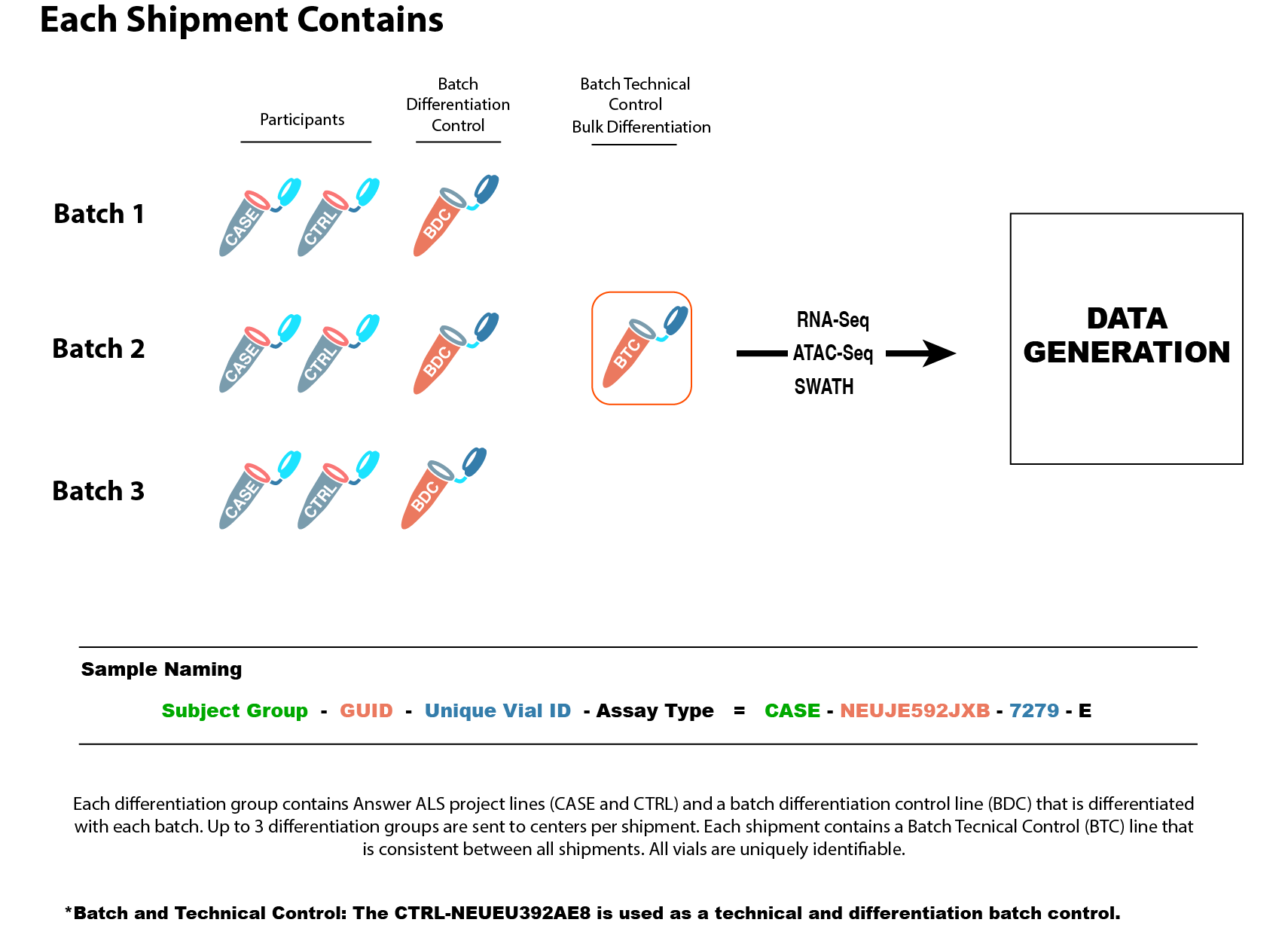
For sample collection, all samples collected at clinical sites were sent to Cedars Sinai for processing and also to NYGC for whole genome sequencing. Induced pluripotent stem cell lines and motor neurons were generated in the same lab with consistent personnel. Batch and technical controls were included to help identify any possible variation generated during production. Below are descriptions of the lines produced.
iPSCs Lines: Derived induced pluripotent stem cells (iPS cells or iPSCs) from participant blood donations to the Answer ALS study. These lines are available through Cedars Sinai Biomanufacturing Center. To learn more, visit the Cedars-Sinai Biomanufacturing Center Website.
Motor Neurons: The iPSCs are differentiated into spinal motor neurons according to the direct iPSC-derived motor neuron (diMNs) protocol developed by Cedars Sinai. These lines are generated through the leadership of Dr. Svendsen and Dr. Sareen, both at Cedars Sinai. You can download a protocol for culturing or collecting the cells here.
Batch and Technical Control: The CTRL-NEUEU392AE8 is used as a technical and differentiation batch control.
Batch technical control (BTC): 2AE8iCTR-n6 line served as BTC and was produced in bulk Oct-Dec 2018. Each OMICs lab is sent a vial from this differentiation with each shipment to run with all the other vials in the shipment. This controls for ‘Omics assay-specific variability’; since BTC pellets were produced simultaneously with an SOP, a given assay should return the same results for any BTC pellet.
Batch differentiation control (BDC): 2AE8iCTR-n6 line is also differentiated with every group of differentiations. This controls for inter-batch variability in differentiation. This line is thawed, expanded, differentiated, and pelleted in addition to the ALS/CTR lines in each batch. OMICs labs receive BDC pellets and ALS/CTR pellets for each differentiation batch.